
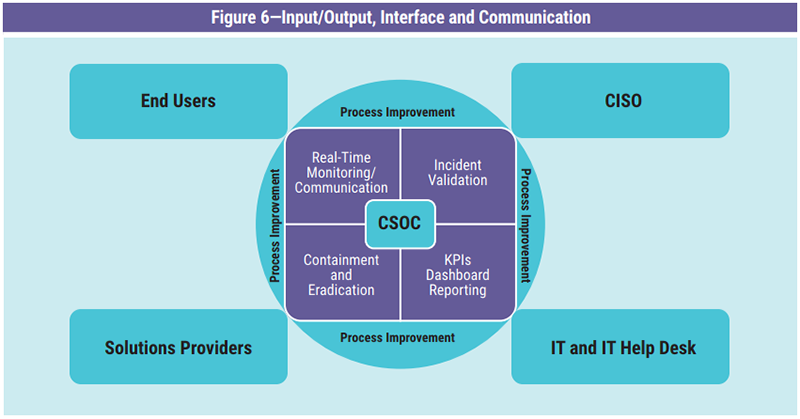
In Part 3, we covered the essential tools and technologies that power a Cyber Security Operations Center (CSOC). Now, in Part 4, we will dive into CSOC processes and workflows, which are crucial for maintaining an effective and efficient security operation.
1. Core CSOC Processes
A well-functioning CSOC follows structured processes and workflows to handle security incidents, monitor threats, and continuously improve its security posture. These processes include:
1️⃣ Incident Detection & Triage
2️⃣ Incident Investigation & Analysis
3️⃣ Incident Response & Mitigation
4️⃣ Threat Hunting
5️⃣ Continuous Security Monitoring
6️⃣ Post-Incident Review & Improvement
Let’s explore each process in detail.
2. Incident Detection & Triage
🔹 Objective:
Quickly detect potential security threats and prioritize them based on severity.
🔹 Workflow:
✔ Log Collection & Correlation – The SIEM continuously collects logs from network devices, endpoints, cloud environments, and security tools.
✔ Alert Generation – Detection rules trigger alerts based on suspicious activity (e.g., failed login attempts, privilege escalations).
✔ Triage & Prioritization – Tier 1 (L1) analysts review alerts and classify them as false positives, low-risk, or high-risk threats.
✔ Escalation – If an alert requires further investigation, it is escalated to L2 analysts for deep analysis.
🔹 Key Questions for Analysts:
🔹 Is this a false positive or a real threat?
🔹 What system or user is affected?
🔹 How urgent is the threat?
🔹 Should this be escalated to L2/L3 for further investigation?
3. Incident Investigation & Analysis
🔹 Objective:
Determine the root cause, attack vector, and impact of a detected security event.
🔹 Workflow:
✔ Log Analysis – L2 analysts review logs from SIEM, EDR, firewalls, and cloud platforms to understand the attack pattern.
✔ Forensic Investigation – If needed, memory and disk analysis tools (e.g., Volatility, Autopsy) are used to examine compromised systems.
✔ Threat Intelligence Correlation – Analysts compare attack indicators (IoCs) with known threat actor TTPs.
✔ Containment Decision – If the attack is ongoing, isolate the affected system to prevent further compromise.
🔹 Key Questions for Analysts:
🔹 How did the attacker gain access?
🔹 What actions did the attacker perform?
🔹 Are other systems compromised?
🔹 Is this part of a larger attack campaign?
4. Incident Response & Mitigation
🔹 Objective:
Contain and eliminate the threat while minimizing business disruption.
🔹 Workflow:
✔ Containment Actions – Block malicious IP addresses, domains, or user accounts in firewalls and endpoint security tools.
✔ Eradication & Recovery – Remove malware, reset credentials, and restore affected systems from backups.
✔ Patch & Secure – Apply security updates, close misconfigured ports, and improve security controls.
✔ Report & Document – Generate an Incident Report for stakeholders and compliance purposes.
🔹 Key Questions for Analysts:
🔹 Have we completely removed the threat?
🔹 Can we recover systems without reintroducing risk?
🔹 What preventive actions should be taken to avoid a recurrence?
5. Threat Hunting
🔹 Objective:
Proactively search for undetected threats inside the network before they cause damage.
🔹 Workflow:
✔ Hypothesis-Driven Hunting – Analysts form hypotheses based on MITRE ATT&CK techniques (e.g., "Are attackers using PowerShell-based persistence?").
✔ Data Analysis – Hunt for suspicious behavior in SIEM logs, EDR telemetry, and network traffic.
✔ IoC Matching – Compare findings with known malware hashes, domains, and IPs from threat intelligence feeds.
✔ Attack Simulation – Red teaming or adversary emulation is conducted to validate detection capabilities.
🔹 Key Questions for Threat Hunters:
🔹 Are there any undetected threats lurking in the network?
🔹 How can we improve detection for sophisticated attacks?
🔹 Are we seeing early indicators of an Advanced Persistent Threat (APT)?
6. Continuous Security Monitoring
🔹 Objective:
Ensure real-time visibility into security events and detect threats before they escalate.
🔹 Workflow:
✔ 24/7 Alert Monitoring – SOC analysts continuously monitor SIEM dashboards and EDR alerts.
✔ Anomaly Detection – Machine learning and behavioral analytics detect suspicious deviations from normal activity.
✔ Log Enrichment – Security logs are enriched with threat intelligence to improve detection accuracy.
✔ Cloud & Endpoint Monitoring – Visibility is expanded to remote endpoints, SaaS applications, and multi-cloud environments.
🔹 Key Monitoring Metrics:
📊 Mean Time to Detect (MTTD) – How fast can threats be identified?
📊 Mean Time to Respond (MTTR) – How quickly can we contain an incident?
📊 False Positive Rate – Are analysts wasting time on unnecessary alerts?
7. Post-Incident Review & Improvement
🔹 Objective:
Learn from past incidents to improve SOC efficiency and security posture.
🔹 Workflow:
✔ Incident Debrief – Analysts conduct a post-mortem review to identify gaps in detection and response.
✔ Detection Rule Updates – SIEM correlation rules and EDR policies are fine-tuned to prevent similar attacks.
✔ Playbook Enhancements – SOAR automation workflows are improved to accelerate incident handling.
✔ Red Team Testing – Simulated attacks (e.g., phishing, ransomware) are conducted to test SOC preparedness.
🔹 Key Questions for Post-Incident Review:
🔹 What worked well during the incident response?
🔹 What could have been done faster?
🔹 Do we need new detection rules, alerts, or automation?
Conclusion
A structured SOC workflow ensures efficient threat detection, investigation, response, and continuous improvement. Here’s a summary of CSOC processes:
🚀 Incident Detection & Triage → 🔎 Investigation & Analysis → 🛡 Incident Response & Mitigation → 🎯 Threat Hunting → 📡 Continuous Monitoring → 🔄 Post-Incident Improvement
In Part 5, we will discuss "Building an Effective CSOC: Best Practices and Challenges." Stay tuned! 🚀
Would you like any refinements before we move to Part 5? 😊

0 comments:
Post a Comment