Monday, March 3, 2025

CSOC 101 - Part 8: CSOC Metrics & KPIs – Measuring SOC Effectiveness


In Part 7, we examined real-world incident response case studies and key lessons learned. Now, in Part 8, we’ll focus on how to measure the effectiveness of a Cyber Security Operations Center (CSOC) using Key Performance Indicators (KPIs) and metrics.

An effective CSOC isn't just about detecting threats—it must also demonstrate efficiency, accuracy, and continuous improvement. Measuring the right KPIs helps organizations evaluate their SOC maturity, response capabilities, and overall security posture.


1. Why CSOC Metrics & KPIs Matter

KPIs help CSOC teams:
✅ Assess the efficiency of threat detection and response.
✅ Identify bottlenecks in security operations.
✅ Improve SOC processes and automation.
✅ Justify budget and resource allocation to leadership.

Without measurable KPIs, it’s difficult to determine whether the CSOC is improving or struggling.


2. Key CSOC Metrics & KPIs

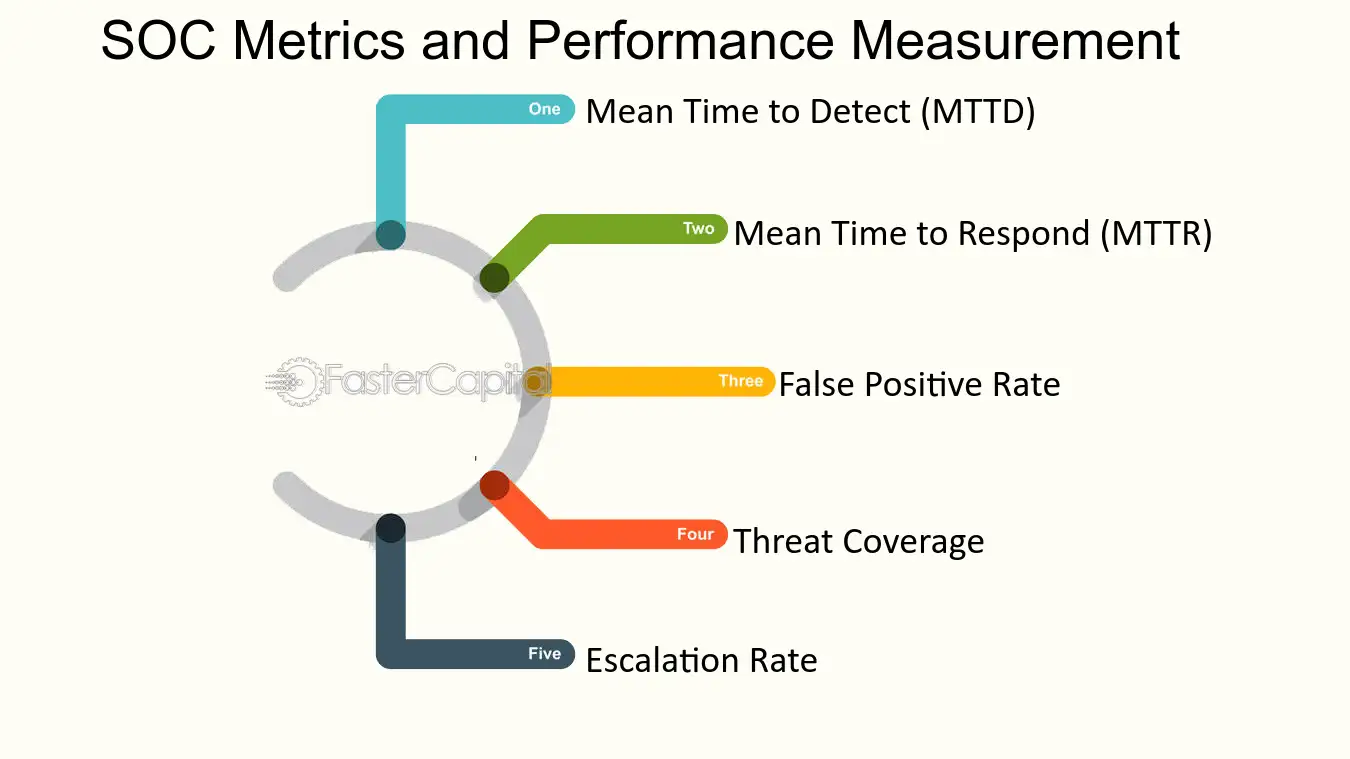
CSOC performance is measured across different categories, including threat detection, response time, threat intelligence, and operational efficiency.

🔹 Detection & Monitoring Metrics

These metrics assess how well the CSOC detects and analyzes threats.

📌 Mean Time to Detect (MTTD)
Definition: The average time it takes for the CSOC to detect a security incident.
Formula:

MTTD=(Time of detectionTime of attack initiation)Total number of incidentsMTTD = \frac{\sum (Time\ of\ detection - Time\ of\ attack\ initiation)}{Total\ number\ of\ incidents}

Goal: Reduce MTTD by improving SIEM rules, EDR analytics, and threat hunting capabilities.

📌 False Positive Rate
Definition: The percentage of alerts that turn out to be false positives.
Formula:

False Positive Rate=(False PositivesTotal Alerts)×100False\ Positive\ Rate = \left(\frac{False\ Positives}{Total\ Alerts}\right) \times 100

Goal: Reduce false positives through better rule tuning and behavioral analytics.

📌 Alert Fatigue Index
Definition: Measures how many alerts analysts investigate daily.
Formula:

Alert Fatigue Index=Total Security AlertsTotal Security AnalystsAlert\ Fatigue\ Index = \frac{Total\ Security\ Alerts}{Total\ Security\ Analysts}

Goal: Reduce analyst fatigue through SOAR automation and AI-driven filtering.


🔹 Incident Response & Containment Metrics

These KPIs evaluate how fast and effectively the CSOC responds to incidents.

📌 Mean Time to Respond (MTTR)
Definition: The average time it takes to contain, mitigate, and resolve an incident.
Formula:

MTTR=(Time of resolutionTime of detection)Total number of incidentsMTTR = \frac{\sum (Time\ of\ resolution - Time\ of\ detection)}{Total\ number\ of\ incidents}

Goal: Reduce MTTR by improving incident response automation and SOAR integration.

📌 Containment Time
Definition: The time taken to isolate an infected system or stop an attack after detection.
Goal: Minimize containment time by deploying EDR auto-response actions (e.g., auto-isolation of compromised endpoints).

📌 Remediation Success Rate
Definition: The percentage of incidents fully remediated after containment.
Formula:

Remediation Success Rate=(Number of fully remediated incidentsTotal number of incidents)×100Remediation\ Success\ Rate = \left(\frac{Number\ of\ fully\ remediated\ incidents}{Total\ number\ of\ incidents}\right) \times 100

Goal: Maintain a high success rate by improving forensic analysis and recovery processes.


🔹 Threat Intelligence & Proactive Hunting Metrics

These metrics assess how well the CSOC anticipates and mitigates threats before they cause damage.

📌 Threat Hunting Effectiveness
Definition: Measures how many undetected threats were found during proactive threat hunting.
Formula:

Threat Hunting Effectiveness=(Total threats detected via threat huntingTotal threats detected)×100Threat\ Hunting\ Effectiveness = \left(\frac{Total\ threats\ detected\ via\ threat\ hunting}{Total\ threats\ detected}\right) \times 100

Goal: Increase effectiveness by improving hunting methodologies and intelligence integration.

📌 Threat Intelligence Utilization Rate
Definition: Measures how often IoCs and TI feeds contribute to real-world threat detection.
Formula:

Threat Intelligence Utilization=(Detections based on threat intelligenceTotal detections)×100Threat\ Intelligence\ Utilization = \left(\frac{Detections\ based\ on\ threat\ intelligence}{Total\ detections}\right) \times 100

Goal: Maximize TI integration with SIEM, EDR, and SOAR tools.

📌 Dwell Time
Definition: The time a threat actor remains undetected inside the network.
Formula:

Dwell Time=Time of containmentTime of initial compromiseDwell\ Time = Time\ of\ containment - Time\ of\ initial\ compromise

Goal: Reduce dwell time by enhancing threat hunting and real-time monitoring.


🔹 CSOC Operational Efficiency Metrics

These KPIs help measure the productivity and effectiveness of SOC analysts.

📌 Analyst Productivity Rate
Definition: Measures how many alerts/incidents an analyst handles per shift.
Formula:

Analyst Productivity=Total Alerts ProcessedTotal SOC AnalystsAnalyst\ Productivity = \frac{Total\ Alerts\ Processed}{Total\ SOC\ Analysts}

Goal: Maintain high efficiency without analyst burnout by leveraging automation.

📌 SOC Automation Efficiency
Definition: Measures how many incidents are resolved using automated playbooks (SOAR) instead of manual investigation.
Formula:

Automation Efficiency=(Incidents resolved via SOARTotal incidents)×100Automation\ Efficiency = \left(\frac{Incidents\ resolved\ via\ SOAR}{Total\ incidents}\right) \times 100

Goal: Increase automation to free up analysts for higher-value tasks (e.g., threat hunting).

📌 SOC Maturity Level
Definition: Assesses how advanced the CSOC is based on frameworks like NIST, MITRE ATT&CK, and SOC-CMM.
Goal: Move from reactive SOC (Level 1) to a proactive SOC (Level 3+) through continuous improvement.


3. How to Improve CSOC Performance Using Metrics

🔹 Optimize SIEM & SOAR Automation – Reduce alert fatigue and MTTR.
🔹 Enhance Threat Intelligence Integration – Improve detection accuracy using real-time TI feeds.
🔹 Train Analysts & Automate Low-Level Tasks – Focus SOC resources on advanced investigations.
🔹 Conduct Regular SOC Maturity Assessments – Improve processes based on KPI insights.
🔹 Test Incident Response with Red Team Exercises – Validate detection and response capabilities.


Conclusion

Measuring CSOC performance using the right KPIs and metrics ensures continuous improvement in threat detection, response, and operational efficiency.

In Part 9, we’ll cover "SOC Maturity Models & How to Evolve from Reactive to Proactive Security", explaining how organizations can level up their SOC capabilities.

CSOC 101 - Part 7: Incident Response Case Studies & Lessons Learned


In Part 6, we explored advanced threat detection techniques for CSOCs. Now, in Part 7, we’ll focus on real-world incident response case studies, analyzing what happened, how the CSOC responded, and key lessons learned.

Incident response is at the heart of SOC operations, and learning from past incidents helps improve detection, containment, and mitigation strategies.


Case Study #1: Ransomware Attack on a Financial Institution

🔹 Incident Overview:

A financial services company suffered a ransomware attack where all critical systems were encrypted, and attackers demanded $2 million in Bitcoin.

🔹 Initial Indicators of Compromise (IoCs):

🔹 Multiple failed RDP login attempts from external IPs.
🔹 Unusual PowerShell script execution.
🔹 Suspicious file encryption activity detected by EDR.

🔹 Incident Response Steps Taken by CSOC:

Detection & Triage: SIEM alerts detected brute-force login attempts and flagged them as a potential attack.
Containment: EDR team isolated infected endpoints and blocked malicious IP addresses.
Investigation: DFIR analysts found that attackers exploited a misconfigured RDP service to gain access.
Eradication: Security team disabled RDP, removed persistence mechanisms, and restored backups.
Recovery: IT team reimaged affected systems and enforced multi-factor authentication (MFA) for remote access.

🔹 Lessons Learned:

Disable unused RDP services or enforce MFA.
Deploy EDR solutions to detect and block file encryption activities.
Regularly backup data and test restoration procedures.
Train employees on phishing awareness to prevent ransomware infections.


Case Study #2: Insider Threat – Data Exfiltration in a Tech Company

🔹 Incident Overview:

A disgruntled employee at a technology firm attempted to steal sensitive source code before leaving the company.

🔹 Initial Indicators of Compromise (IoCs):

🔹 A non-admin employee suddenly accessed restricted Git repositories.
🔹 Large data transfer detected from the internal network to an external cloud storage provider.
🔹 The employee disabled endpoint security tools on their laptop.

🔹 Incident Response Steps Taken by CSOC:

Detection & Investigation: UEBA analytics detected anomalous file access patterns.
Containment: CSOC team revoked the employee’s access and monitored ongoing activity.
Response & Mitigation: IT security team blocked external transfers to unauthorized storage.
Forensic Analysis: Digital forensics tools confirmed that no data was successfully exfiltrated.

🔹 Lessons Learned:

Implement strict access controls and least privilege principles.
Enable Data Loss Prevention (DLP) policies to prevent unauthorized transfers.
Monitor employee activity for suspicious behavior, especially during offboarding.
Use behavioral analytics (UEBA) to detect unusual access patterns.


Case Study #3: Supply Chain Attack via Compromised Third-Party Vendor

🔹 Incident Overview:

A major retailer suffered a security breach when attackers compromised a third-party vendor’s credentials, leading to unauthorized access to the company’s payment processing system.

🔹 Initial Indicators of Compromise (IoCs):

🔹 An external IP accessed critical payment infrastructure outside normal business hours.
🔹 Security logs showed anomalous admin login behavior from a vendor account.
🔹 SIEM flagged suspicious SQL queries extracting payment card data.

🔹 Incident Response Steps Taken by CSOC:

Detection: SIEM and EDR alerts detected unusual login activity from the vendor account.
Containment: CSOC team revoked the vendor’s access and implemented network segmentation.
Investigation: Analysts discovered stolen vendor credentials were used in the attack.
Mitigation: Security team reset all vendor credentials and enforced stronger authentication policies.

🔹 Lessons Learned:

Implement strict vendor access controls and zero-trust architecture.
Monitor third-party activity for unusual behavior.
Use multi-factor authentication (MFA) for vendor accounts.
Regularly audit vendor security compliance and access policies.


Case Study #4: Phishing Attack on Corporate Executives

🔹 Incident Overview:

A CEO and CFO of a multinational corporation were targeted in a spear-phishing campaign that led to a business email compromise (BEC) attack.

🔹 Initial Indicators of Compromise (IoCs):

🔹 A fake login page for Microsoft 365 was accessed multiple times from the executive’s laptop.
🔹 Multiple password reset attempts from unrecognized IP addresses.
🔹 Email forwarding rules were created to redirect financial emails to an external attacker-controlled address.

🔹 Incident Response Steps Taken by CSOC:

Detection: SOC analysts noticed multiple failed login attempts from a foreign IP.
Containment: Security team reset compromised credentials and revoked unauthorized sessions.
Investigation: Email logs showed that attackers used a fake login page to harvest credentials.
Mitigation: IT enforced MFA and conditional access policies to prevent further compromise.

🔹 Lessons Learned:

Enable multi-factor authentication (MFA) for all corporate accounts.
Train executives on phishing awareness and social engineering tactics.
Deploy email security tools to detect phishing attempts.
Regularly audit email forwarding rules to prevent unauthorized redirection.


Key Takeaways from These Incidents

From these real-world case studies, we can extract key lessons for CSOCs to strengthen their detection and response capabilities:

🔍 Detection & Prevention Best Practices

Monitor login anomalies and enforce MFA to prevent unauthorized access.
Deploy behavioral analytics (UEBA) to detect insider threats and suspicious data transfers.
✔ **Use SIEM, SOAR, and EDR tools to automate threat detection and response.

🛡 Incident Response & Mitigation Best Practices

Have predefined playbooks for common attack scenarios (e.g., ransomware, phishing, insider threats).
Use digital forensics tools to analyze breaches and improve security post-incident.
Regularly update and enforce security policies for vendors, employees, and privileged users.

🚀 Continuous Security Improvement

✔ Conduct red team / blue team exercises to test SOC effectiveness.
✔ Implement continuous training for security analysts on emerging threats.
✔ Maintain regular threat intelligence updates to stay ahead of cyber adversaries.


Conclusion

Incident response is a continuous learning process. Studying real-world security breaches helps CSOCs develop better detection techniques, response plans, and risk mitigation strategies.

In Part 8, we will explore "CSOC Metrics & KPIs: Measuring SOC Effectiveness", covering key performance indicators (KPIs) and how organizations assess SOC maturity.

CSOC 101 - Part 6: Advanced Threat Detection Techniques for CSOC Teams


In Part 5, we discussed how to build an effective CSOC by implementing best practices and overcoming key challenges. Now, in Part 6, we’ll focus on advanced threat detection techniques that can enhance a CSOC's detection capabilities, helping analysts identify sophisticated cyber threats before they cause damage.

1. The Evolution of Threat Detection

Traditional threat detection methods relied heavily on signature-based detection (e.g., antivirus, IDS/IPS rules), which worked well for known threats. However, modern attackers use zero-day exploits, fileless malware, and advanced persistent threats (APTs) that evade traditional defenses.

To stay ahead of these threats, CSOCs must adopt advanced threat detection techniques, including:
Behavioral analytics & anomaly detection
MITRE ATT&CK-based detection
Threat intelligence correlation
Machine learning & AI-driven security
Threat hunting methodologies


2. Behavioral Analytics & Anomaly Detection

🔹 What Is It?

Instead of relying solely on signatures or rules, behavioral analytics detects suspicious deviations from normal activity in an environment.

🔹 How It Works:

User and Entity Behavior Analytics (UEBA) – Tracks normal user and system behaviors to detect anomalies (e.g., insider threats, credential compromise).
Network Behavior Analysis (NBA) – Monitors east-west traffic inside the network for lateral movement and data exfiltration attempts.
Baseline Profiling – Uses historical data to establish a baseline and flag deviations.

🔹 Example Use Cases:

Account Takeover Detection – An employee logs in from Indonesia at 9 AM, then logs in from Germany at 9:05 AM → Suspicious behavior detected.
Data Exfiltration – A non-IT employee suddenly starts transferring gigabytes of data to an unknown external server.
Insider Threat Detection – A finance user accesses engineering servers they’ve never accessed before.

🔹 Tools for Behavioral Analytics:

🔹 Splunk UEBA
🔹 Microsoft Defender for Identity
🔹 Exabeam
🔹 Darktrace AI


3. MITRE ATT&CK-Based Detection

🔹 What Is It?

MITRE ATT&CK is a knowledge base of real-world attack techniques used by adversaries. It helps SOC teams map attack behaviors and improve threat detection.

🔹 How to Use MITRE ATT&CK for Detection:

Map Alerts to MITRE ATT&CK – Identify which tactics, techniques, and procedures (TTPs) adversaries are using.
Create Threat Detection Rules – Develop SIEM correlation rules based on MITRE ATT&CK techniques.
Hunt for Known Adversaries – Use threat intelligence feeds to search for APT activity in your environment.

🔹 Example Use Cases:

Credential Dumping (T1003) – Detects attempts to extract LSASS memory for password hashes.
PowerShell Abuse (T1059.001) – Flags suspicious PowerShell execution from non-administrative users.
C2 Beaconing (T1071) – Identifies persistent C2 communication from infected hosts.

🔹 Tools for MITRE ATT&CK Integration:

🔹 Sigma Rules – Open-source threat detection rules mapped to MITRE ATT&CK.
🔹 Elastic Security (Kibana) – Maps logs to MITRE ATT&CK techniques.
🔹 MITRE ATT&CK Navigator – Visualizes attack techniques observed in a network.


4. Threat Intelligence Correlation

🔹 What Is It?

Threat Intelligence (TI) enhances threat detection by correlating security alerts with real-world attacker tactics, malware hashes, IP addresses, and domains.

🔹 How to Use Threat Intelligence for Detection:

Automate IoC Matching – Ingest threat intelligence feeds into SIEM, SOAR, and EDR tools.
Correlate Threat Actor TTPs – Match security incidents to known APT groups (e.g., APT29, Lazarus Group).
Monitor Dark Web & Cybercrime Markets – Track stolen credentials and leaked sensitive data.

🔹 Example Use Cases:

Ransomware Attack Prevention – Detect an endpoint communicating with a known ransomware C2 domain.
Phishing Domain Detection – Identify emails containing links to domains flagged as malicious by TI providers.
APT Tracking – Correlate adversary infrastructure (IP, domains, tools) with activity inside the organization.

🔹 Tools for Threat Intelligence Integration:

🔹 MISP (Malware Information Sharing Platform)
🔹 VirusTotal Intelligence
🔹 AlienVault OTX
🔹 Recorded Future


5. Machine Learning & AI-Driven Security

🔹 What Is It?

AI and Machine Learning (ML) enhance threat detection by analyzing massive datasets, identifying patterns, and detecting anomalies faster than humans.

🔹 How AI Improves Threat Detection:

Predictive Analytics – AI learns from past incidents to predict future attack patterns.
Adaptive Detection – ML models adjust detection rules based on real-time network activity.
Automated Response – AI-powered SOAR platforms can automatically mitigate low-level threats.

🔹 Example Use Cases:

Zero-Day Attack Detection – AI detects previously unseen malware variants by analyzing behavior.
Phishing Detection – AI scans email content, headers, and links to detect sophisticated phishing attacks.
Malware Sandboxing – ML-based malware analysis identifies polymorphic malware that traditional AV misses.

🔹 AI-Powered Security Tools:

🔹 Darktrace (AI-Based Anomaly Detection)
🔹 CrowdStrike Falcon AI
🔹 Microsoft Defender AI-Powered Threat Protection
🔹 Cortex XSOAR (AI-Powered SOAR)


6. Proactive Threat Hunting Methodologies

🔹 What Is It?

Threat hunting is a proactive approach where SOC analysts actively search for hidden threats instead of waiting for alerts.

🔹 Threat Hunting Techniques:

Hypothesis-Based Hunting – Analysts develop a hypothesis based on MITRE ATT&CK and threat intelligence.
IoC-Based Hunting – Search for known indicators of compromise (IP, hashes, domains) inside SIEM logs.
Behavioral Hunting – Identify abnormal login patterns, lateral movement, and persistence techniques.

🔹 Example Use Cases:

Detecting Living-Off-The-Land Attacks – Search for suspicious usage of native OS tools (PowerShell, WMIC, LOLBins).
C2 Communication Detection – Hunt for beacons to rare domains, DNS tunneling, or encrypted traffic anomalies.
Insider Threat Monitoring – Analyze user behavior for data exfiltration attempts.

🔹 Tools for Threat Hunting:

🔹 Sigma Rules & YARA Rules
🔹 Splunk & ELK Query-Based Hunting
🔹 Velociraptor (DFIR & Threat Hunting Tool)
🔹 TheHive (Threat Hunting & Incident Response Platform)


Conclusion

To effectively detect modern cyber threats, CSOCs must evolve beyond traditional signature-based detection and adopt advanced threat detection techniques like:

🔍 Behavioral Analytics & UEBA – Detects anomalies based on user behavior.
🎯 MITRE ATT&CK-Based Detection – Maps alerts to real-world attack techniques.
🛡 Threat Intelligence Correlation – Enhances detection by integrating TI feeds.
🤖 AI-Driven Security – Uses ML models for automated threat analysis.
🚀 Proactive Threat Hunting – Finds hidden threats that automated tools may miss.

In Part 7, we will explore "Incident Response Case Studies & Lessons Learned" – real-world examples of how CSOCs handle cyber incidents.

CSOC 101 - Part 5: Building an Effective CSOC – Best Practices & Challenges


In Part 4, we explored the core processes and workflows that drive a Cyber Security Operations Center (CSOC). Now, in Part 5, we will discuss how to build an effective CSOC, covering best practices and the challenges organizations face in managing their security operations.

1. Key Elements of an Effective CSOC

A highly functional CSOC requires the right mix of people, processes, and technology to provide real-time security monitoring and incident response. The following components are essential:

🔹 A Well-Defined CSOC Strategy

A successful CSOC requires a clear strategy aligned with the organization's business objectives, risk tolerance, and compliance requirements.

Key Focus Areas:24/7 Monitoring Coverage – Ensure that the CSOC operates round the clock or has automated threat response mechanisms.
Incident Response Readiness – Establish well-documented incident response playbooks and ensure they are tested regularly.
Threat Intelligence Integration – Leverage CTI to anticipate threats and improve proactive detection.
Continuous Improvement – Regularly review SOC performance, update detection rules, and conduct red team/blue team exercises.


🔹 Skilled & Trained Security Analysts

CSOC analysts are at the core of security operations. They need continuous training and upskilling to stay ahead of evolving threats.

Best Practices: ✅ Hire and train analysts with technical expertise in cybersecurity (SIEM, EDR, threat hunting, forensics).
✅ Encourage certifications such as GCIH, GCFA, OSCP, CISSP, CEH, and CISM to strengthen skills.
✅ Foster a learning culture through CTF competitions, threat intelligence analysis, and hands-on labs.
✅ Implement shift rotation schedules to prevent analyst burnout.

Common Challenge:
🔴 Skill Shortage – The cybersecurity industry faces a talent gap, making it difficult to find experienced SOC analysts.


🔹 The Right Security Tools & Automation

The effectiveness of a CSOC depends on having robust security tools that provide visibility, threat detection, and automation.

Essential Tools: 📌 SIEM (Security Information and Event Management) – Correlates logs and detects threats (e.g., Splunk, Sentinel, QRadar).
📌 EDR/XDR (Endpoint Detection & Response) – Monitors endpoint activity and automates response (e.g., CrowdStrike, Microsoft Defender, SentinelOne).
📌 SOAR (Security Orchestration, Automation, and Response) – Automates repetitive tasks and improves response time (e.g., Cortex XSOAR, Splunk SOAR).
📌 Threat Intelligence Platform (TIP) – Enhances detection capabilities with threat intelligence feeds (e.g., MISP, Recorded Future).
📌 Vulnerability Management Tools – Identifies security weaknesses (e.g., Nessus, Qualys, Rapid7).

Common Challenge:
🔴 Tool Overload & Alert Fatigue – Too many tools generate excessive alerts, leading to analyst burnout and missed incidents.

Solution: Implement SIEM tuning, threat intelligence filtering, and automation (SOAR) to reduce noise.


🔹 Well-Defined Incident Response (IR) Plan

A well-structured Incident Response (IR) Plan ensures that security teams can react quickly and effectively when a cyberattack occurs.

Best Practices:Define Clear IR Playbooks – Document step-by-step procedures for handling different attack scenarios (e.g., phishing, ransomware, insider threats).
Conduct Tabletop Exercises – Simulate security incidents to test IR readiness and identify gaps.
Red Team / Blue Team Drills – Engage in attack simulations to validate SOC detection and response capabilities.
Regulatory Compliance – Align the IR plan with standards like ISO 27001, NIST, GDPR, PCI-DSS.

Common Challenge:
🔴 Unclear Roles & Responsibilities – Without predefined roles, incident response efforts become chaotic and inefficient.

Solution: Assign clear responsibilities to each SOC team member (L1, L2, L3, SOC Manager) during an incident.


2. Challenges in Running a CSOC

Even with best practices, organizations face several challenges in managing a CSOC effectively.

🔴 Challenge 1: Alert Fatigue & False Positives

  • SOC analysts are overwhelmed by high volumes of alerts, many of which are false positives.
  • Critical threats might be overlooked due to alert overload.

Solution:
✔ Fine-tune SIEM correlation rules to reduce unnecessary alerts.
✔ Implement AI/ML-based threat detection to filter out low-priority alerts.
✔ Use SOAR automation to prioritize alerts based on risk scoring.


🔴 Challenge 2: Shortage of Skilled Cybersecurity Talent

  • There is a global shortage of experienced SOC analysts.
  • Hiring, training, and retaining skilled analysts is a major challenge.

Solution:
✔ Train existing IT/security staff in SOC operations.
✔ Implement SOC-as-a-Service (MSSP/VSOC) to outsource some security operations.
✔ Automate repetitive tasks with SOAR & AI-powered security tools.


🔴 Challenge 3: Keeping Up with Evolving Threats

  • Cybercriminals are constantly adapting their attack techniques (e.g., zero-day exploits, supply chain attacks, and ransomware).
  • Traditional security measures often fail against Advanced Persistent Threats (APT).

Solution:
Threat Hunting Programs – Proactively search for hidden threats in networks.
Threat Intelligence Integration – Use CTI to track attacker TTPs and enhance detection capabilities.
Red Team Testing – Regularly simulate cyberattacks to evaluate SOC effectiveness.


🔴 Challenge 4: Lack of Security Automation

  • Manual incident response processes slow down threat detection and mitigation.
  • Delays in response time increase the impact of ransomware, data breaches, and insider threats.

Solution:
✔ Deploy SOAR to automate security workflows and reduce response times.
✔ Use EDR/XDR solutions to enable automatic threat containment.
✔ Leverage cloud-native security automation for faster remediation in cloud environments.


3. Steps to Build a Stronger CSOC

To enhance CSOC effectiveness, organizations should focus on the following steps:

Step 1: Define a Clear CSOC Strategy – Align CSOC goals with business risk management.
Step 2: Hire & Train SOC Analysts – Upskill analysts through CTFs, threat hunting, and real-world attack simulations.
Step 3: Optimize Security Tools & Automation – Implement SIEM tuning, SOAR automation, and AI-driven threat detection.
Step 4: Conduct Regular Threat Hunting & Red Teaming – Validate detection capabilities against real-world cyber threats.
Step 5: Continuous Improvement & Compliance – Adapt SOC operations to emerging threats and regulatory changes.


Conclusion

Building an effective CSOC requires a combination of skilled analysts, optimized processes, advanced tools, and continuous improvement. Organizations must focus on reducing alert fatigue, automating threat response, and proactively hunting threats to stay ahead of cybercriminals.

In Part 6, we will explore "Advanced Threat Detection Techniques for CSOC Teams," covering MITRE ATT&CK, behavioral analytics, and AI-driven security. 🚀