
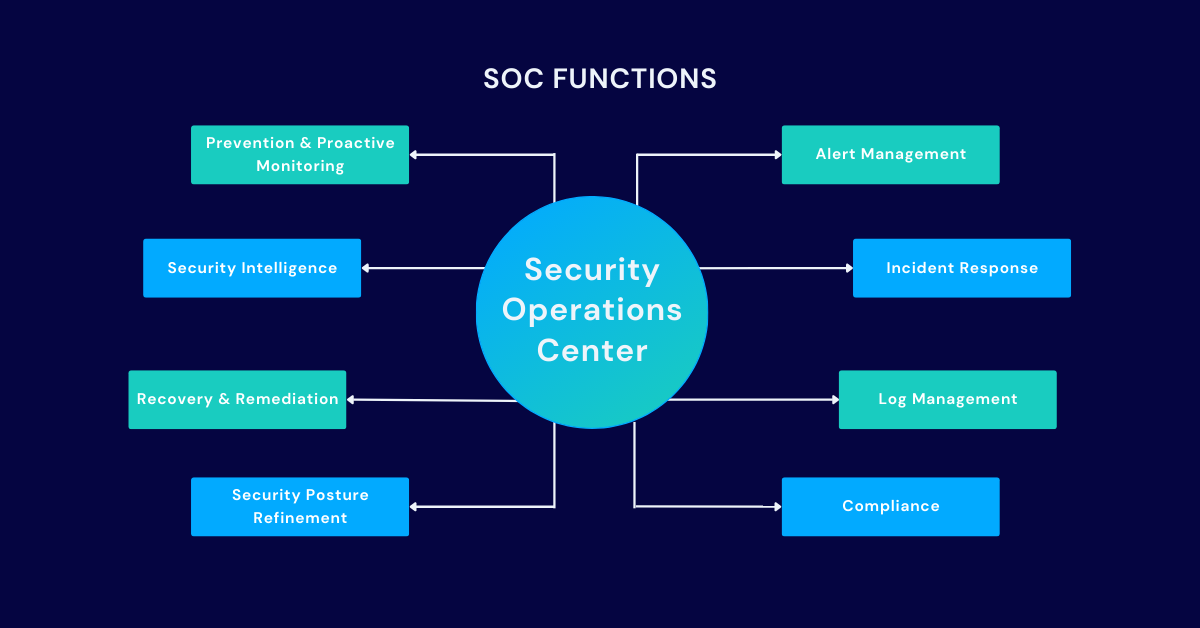
Congratulations on reaching the final part of the CSOC 101 series! 🎉 Over the past ten parts, we have covered everything from SOC fundamentals to advanced detection techniques, automation, and the future of Next-Gen SOCs (iSOC).
Now, let's summarize the key lessons and provide a practical action plan for organizations looking to build, improve, or transition their SOC operations.
1. Key Takeaways from CSOC 101
🔹 Part 1 – Introduction to SOC
✔ A Cyber Security Operations Center (CSOC) is responsible for detecting, investigating, responding to, and mitigating cyber threats.
✔ CSOCs can be in-house, hybrid, or outsourced (MSSP/VSOC) depending on an organization’s needs.
🔹 Part 2 – SOC Roles & Responsibilities
✔ SOC teams are structured into L1, L2, and L3 analysts, SOC engineers, CTI analysts, and SOC managers.
✔ SOC collaboration with Red Teams, Incident Response, and IT Operations is crucial.
🔹 Part 3 – Essential SOC Tools & Technologies
✔ SOCs rely on SIEM, EDR/XDR, SOAR, IDS/IPS, Threat Intelligence Platforms, DFIR, and ASM tools.
✔ Automation (SOAR) and AI-driven detection (UEBA, ML-based analytics) are becoming standard.
🔹 Part 4 – SOC Processes & Workflows
✔ The SOC workflow follows a cycle: Detection → Investigation → Response → Threat Hunting → Continuous Monitoring.
✔ SOC efficiency depends on playbooks, automation, and proactive security strategies.
🔹 Part 5 – Building an Effective SOC: Best Practices & Challenges
✔ Common SOC challenges include alert fatigue, false positives, talent shortages, and evolving attack techniques.
✔ Implement SOAR automation, CTI integration, and AI-driven threat detection to improve efficiency.
🔹 Part 6 – Advanced Threat Detection Techniques
✔ Move beyond signature-based detection by integrating MITRE ATT&CK mapping, behavioral analytics, and AI-driven security.
✔ Threat hunting and real-time IoC correlation improve detection accuracy.
🔹 Part 7 – Incident Response Case Studies & Lessons Learned
✔ Real-world case studies of ransomware, insider threats, supply chain attacks, and phishing highlight the importance of rapid response & remediation.
✔ Best practices: Enable MFA, enforce least privilege, conduct regular threat hunting, and automate containment.
🔹 Part 8 – SOC Metrics & KPIs
✔ SOC performance is measured using MTTD, MTTR, false positive rate, threat hunting effectiveness, and automation efficiency.
✔ SOC leaders should track KPIs to improve security maturity and operational efficiency.
🔹 Part 9 – SOC Maturity Models
✔ SOCs evolve from reactive (Level 1) to proactive (Level 5) intelligence-driven security operations.
✔ Mature SOCs integrate SOAR, CTI, AI-based detection, and adversary simulation (Red Teaming).
🔹 Part 10 – Next-Gen SOC (iSOC) & Future Trends
✔ The Next-Gen SOC (iSOC) is powered by AI, XDR, predictive analytics, deception technology, and automation.
✔ Future SOCs will incorporate Zero Trust, Quantum-Safe Security, and Threat Hunting-as-a-Service (THaaS).
2. Action Plan: How to Build or Improve a SOC
If you're building or optimizing a SOC, here’s a step-by-step roadmap:
📌 Phase 1: Establish Core SOC Operations (0-6 Months)
✅ Deploy SIEM & Log Management to centralize security monitoring.
✅ Implement 24/7 SOC Monitoring with L1/L2 analysts.
✅ Develop Incident Response Playbooks for ransomware, phishing, insider threats, and cloud security incidents.
✅ Ensure basic security tools: EDR, IDS/IPS, vulnerability management.
📌 Phase 2: Enhance Threat Detection & Response (6-12 Months)
✅ Integrate SOAR automation to reduce manual alert triage.
✅ Establish Threat Intelligence (TI) feeds and IoC correlation.
✅ Improve SIEM rule tuning to minimize false positives.
✅ Conduct Red Team/Blue Team exercises to validate detection capabilities.
📌 Phase 3: Move to a Proactive & Intelligence-Driven SOC (12-24 Months)
✅ Deploy Extended Detection & Response (XDR) for cross-platform analytics.
✅ Build a dedicated Threat Hunting Team using MITRE ATT&CK-based methodologies.
✅ Implement behavioral analytics (UEBA) for insider threat detection.
✅ Establish Deception Technology (honeypots, honey tokens) to detect lateral movement.
📌 Phase 4: Transition to a Fully Automated & AI-Powered SOC (24+ Months)
✅ Integrate AI-driven threat detection & predictive security analytics.
✅ Implement Zero Trust SOC architecture.
✅ Expand SOC visibility to multi-cloud environments.
✅ Move towards Security Fusion Centers, unifying SOC, CTI, and Red Team operations.
3. SOC Transformation Checklist
✅ Do we have 24/7 security monitoring?
✅ Is our SIEM tuned to reduce false positives?
✅ Do we integrate threat intelligence (CTI) for proactive security?
✅ Are we automating response with SOAR?
✅ Are we conducting regular Red Team & adversary simulations?
✅ Have we adopted XDR, AI, or behavioral analytics for detection?
✅ Is our SOC evolving towards a Zero Trust model?
4. Final Thoughts
Building a modern SOC is a continuous journey, requiring:
🔹 A skilled security team
🔹 Advanced detection & response tools
🔹 AI-driven automation & intelligence-led security
🔹 Continuous improvement through Red Teaming & Threat Hunting
🎯 The future of SOCs is not just detection & response—it’s predictive security that prevents attacks before they happen.
🚀 Now it’s your turn! What’s your next step in SOC transformation? Do you need templates, frameworks, or more guidance? Let’s discuss! 😊

0 comments:
Post a Comment