
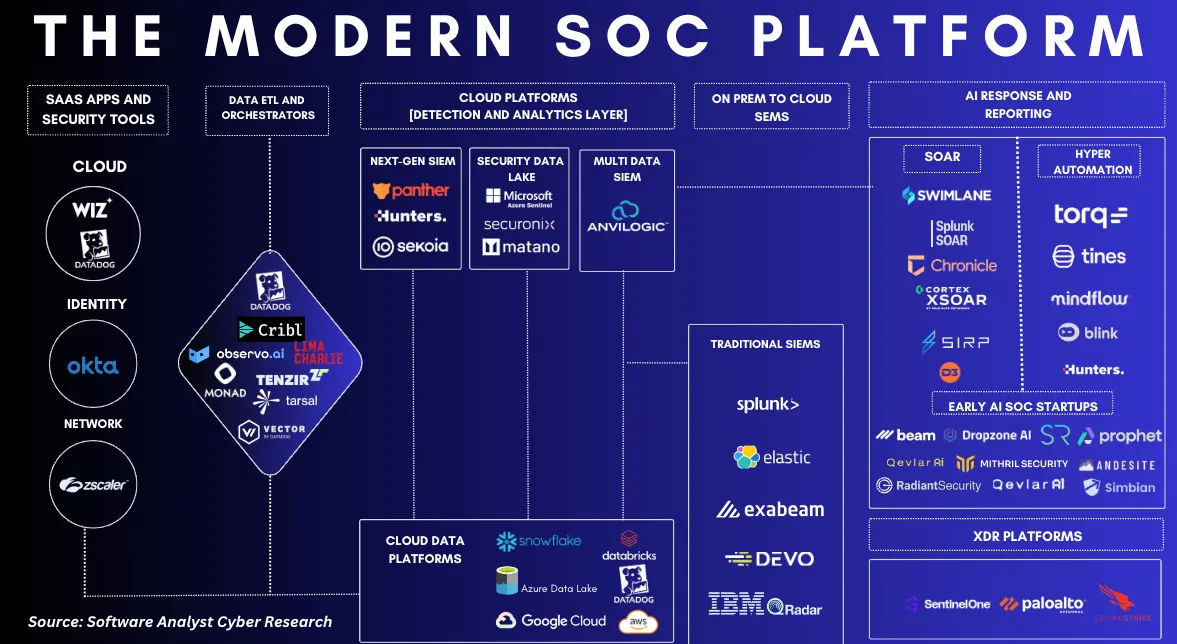
In Part 9, we explored SOC maturity models and how organizations evolve from reactive security operations to a fully intelligence-driven SOC. Now, in Part 10, we’ll discuss how to build a Next-Generation SOC (iSOC) and the future trends shaping security operations.
1. What is a Next-Generation SOC (iSOC)?
A Next-Generation SOC (iSOC) goes beyond traditional threat detection and response by integrating AI, automation, extended detection, and predictive analytics.
🔹 Traditional SOC – Relies on manual investigations, SIEM, and rule-based alerts.
🔹 Next-Gen SOC (iSOC) – Uses AI-driven analytics, proactive hunting, deception technology, and automated response.
📌 Key Characteristics of iSOC:
✅ AI & ML-Powered Threat Detection – Uses machine learning to detect zero-day attacks.
✅ Extended Detection & Response (XDR) – Provides cross-platform threat correlation.
✅ Cyber Threat Intelligence (CTI) Integration – Maps adversary tactics in real time.
✅ Deception Technology – Uses honeypots, honeytokens, and decoy systems.
✅ Predictive Security Analytics – Identifies attacks before they happen.
✅ Cloud-Native Security – Monitors SaaS, hybrid cloud, and multi-cloud environments.
📌 Why Build a Next-Gen SOC?
⚡ Traditional SOCs struggle with alert overload, advanced threats, and evolving attack techniques. An iSOC enhances efficiency, accuracy, and automation to stay ahead of modern cyber threats.
2. Key Technologies in a Next-Gen SOC
To transform a traditional SOC into an iSOC, organizations must integrate emerging security technologies.
🔹 AI & Machine Learning for Threat Detection
✔ AI-driven User and Entity Behavior Analytics (UEBA) detects insider threats and anomalies.
✔ ML models predict attack patterns based on past incidents.
✔ AI automates triage, reducing false positives and alert fatigue.
📌 Tools:
🔹 Darktrace AI, Microsoft Defender AI, CrowdStrike Falcon AI
🔹 Extended Detection & Response (XDR)
✔ Correlates network, endpoint, email, and cloud telemetry to provide deeper attack visibility.
✔ Reduces dwell time by detecting lateral movement across environments.
📌 Tools:
🔹 Microsoft Defender XDR, Palo Alto Cortex XDR, CrowdStrike Falcon XDR
🔹 Cyber Threat Intelligence (CTI) Integration
✔ Uses real-time threat intelligence to map adversary tactics (MITRE ATT&CK).
✔ Automates IoC (Indicator of Compromise) correlation with SIEM & SOAR.
📌 Tools:
🔹 MISP, Recorded Future, AlienVault OTX, Anomali ThreatStream
🔹 SOAR & Security Automation
✔ Automates repetitive SOC tasks (e.g., blocking malicious IPs, isolating endpoints).
✔ Reduces MTTR (Mean Time to Respond) by integrating automated playbooks.
📌 Tools:
🔹 Splunk SOAR (Phantom), Cortex XSOAR, IBM Resilient
🔹 Deception Technology & Honeypots
✔ Deploys decoy systems (honeypots, honeytokens, fake credentials) to lure attackers.
✔ Helps detect early-stage reconnaissance and supply chain attacks.
📌 Tools:
🔹 Canary Tokens, Thinkst Canary, Illusive Networks
🔹 Predictive Security Analytics
✔ Uses big data analytics & AI models to predict potential security incidents.
✔ Helps SOC teams prioritize high-risk alerts before an attack occurs.
📌 Tools:
🔹 Google Chronicle, AWS GuardDuty, Exabeam Security Analytics
3. Future Trends in SOC Operations
As cyber threats evolve, SOC operations must adopt new methodologies and frameworks.
🔹 AI-Driven SOC Automation
⚡ AI-powered SOAR & SIEM will dominate SOC operations, reducing manual workload.
⚡ AI-based SOC chatbots will assist analysts in investigations & triage.
🔹 Cloud-Native Security & Zero Trust SOC
⚡ SOCs must monitor multi-cloud, SaaS, and hybrid environments.
⚡ Zero Trust will be embedded into SOC workflows to enforce strict identity controls.
📌 Example: Google BeyondCorp, Microsoft Zero Trust Model
🔹 Threat Hunting-as-a-Service (THaaS)
⚡ Organizations will outsource proactive threat hunting to specialized threat intelligence firms.
📌 Example: CrowdStrike Falcon OverWatch, Palo Alto Unit 42
🔹 Quantum-Resistant Security Monitoring
⚡ As quantum computing advances, SOCs must monitor post-quantum cryptographic threats.
⚡ Quantum-Safe Cryptography will be integrated into SOC detection mechanisms.
📌 Example: NIST’s Post-Quantum Cryptography Project
4. Steps to Transition to a Next-Gen SOC
Organizations can gradually upgrade their SOC by following a structured roadmap.
🔹 Phase 1: Strengthen Core Security Operations
✅ Deploy SIEM, EDR, and Vulnerability Management.
✅ Automate incident response with SOAR.
🔹 Phase 2: Integrate Threat Intelligence & Advanced Detection
✅ Use Threat Intelligence Feeds (MISP, Recorded Future).
✅ Implement MITRE ATT&CK-based detection & analytics.
🔹 Phase 3: Deploy AI-Driven Security & Automation
✅ Implement AI-based behavioral analytics (UEBA).
✅ Use ML-driven anomaly detection for proactive threat hunting.
🔹 Phase 4: Adopt Predictive Security & Full SOC Automation
✅ Deploy XDR for cross-platform correlation.
✅ Integrate AI-driven SOAR playbooks.
5. Challenges in Implementing a Next-Gen SOC
📌 High Costs & Complexity – Advanced AI & automation tools require significant investment.
📌 Talent Shortage – Requires highly skilled SOC analysts & AI specialists.
📌 Data Overload – AI models must be fine-tuned to avoid alert fatigue & false positives.
✅ Solution:
✔ Gradually implement iSOC components in phases.
✔ Invest in AI-driven SOAR & XDR automation.
✔ Partner with MSSPs for 24/7 managed SOC services.
Conclusion
The Next-Generation SOC (iSOC) is the future of cybersecurity operations, providing AI-powered automation, real-time threat intelligence, predictive analytics, and zero-trust enforcement.
Key Takeaways:
🚀 iSOC combines AI, XDR, SOAR, CTI, and Predictive Analytics to enhance SOC capabilities.
🚀 Organizations must gradually evolve from traditional SIEM-based SOCs to an AI-driven, automated model.
🚀 Future SOCs will integrate deception technology, quantum-safe security, and zero-trust frameworks.

0 comments:
Post a Comment